

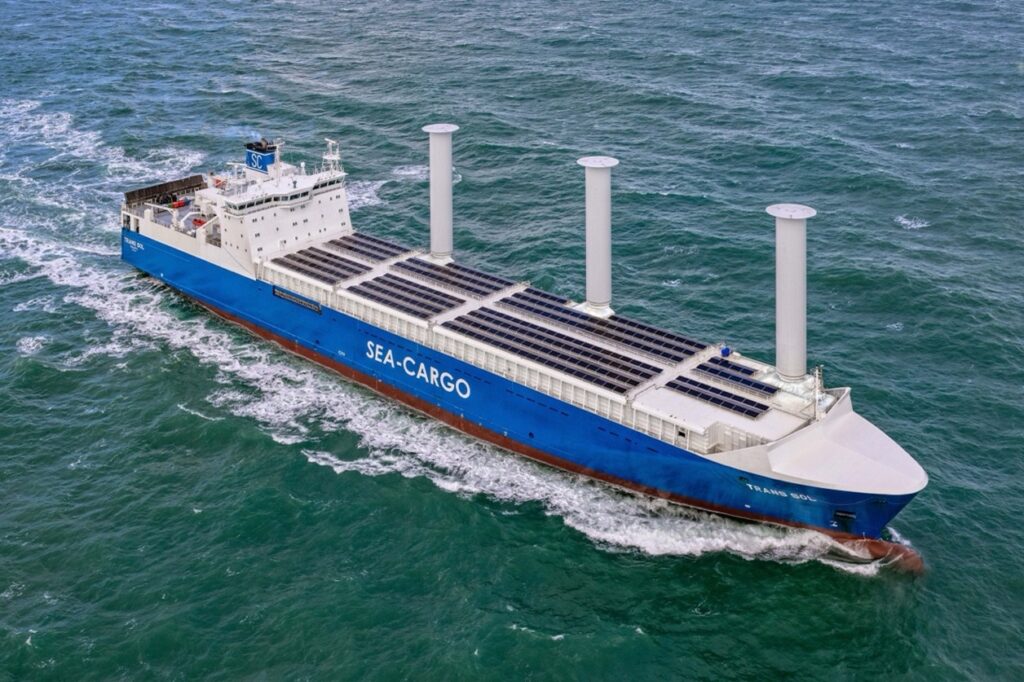
Norsepower, the global leader in wind propulsion systems for ships, today announces that Trans Hav and Trans Sol, operated by Sea-Cargo, have officially entered full commercial operations following extensive retrofit upgrades designed to significantly improve fuel efficiency and reduce greenhouse gas emissions.
April 17, 2026. Helsinki, Finland: At the heart of the upgrade are three Norsepower Rotor Sails™ installed on each vessel, delivered and commissioned during January–February 2026 at RHB and ROG repair yards in Rotterdam. The installations form a key component of one of the most advanced retrofit projects in Northern European short-sea shipping.
The decision to expand wind propulsion across the fleet was driven by Sea-Cargo’s positive long-term operational experience with rotor sails onboard SC Connector, demonstrating both the technical reliability and commercial viability of the technology in fixed liner operations.
This project’s exceptional character is not only dictated by the scale of the upgrade, but also by the speed and operational efficiency of the installation process. Norsepower successfully installed and commissioned all rotor sails without taking the vessels out of service at any point, which is a critical factor for operators in scheduled liner trades.
The mechanical installation of the rotor sails was completed in as little as two working days per vessel, without night shifts, while commissioning and performance testing were carried out during normal vessel operations.
Heikki Pöntynen, CEO of Norsepower, said: “This project is a strong example of how wind propulsion can be deployed quickly, efficiently and without disrupting commercial operations. For shipowners, avoiding off-hire time is critical, and we are proud to have delivered a solution that integrates seamlessly into the vessels’ schedule while delivering immediate performance benefits. Building on Sea-Cargo’s proven experience with NPRS, this marks an important step in scaling wind propulsion across modern fleets.”
The Norsepower Rotor Sails are part of a broader integrated energy platform onboard Trans Hav and Trans Sol, combining wind propulsion with solar power, battery storage, advanced power management systems and optimised propulsion configurations. Together, these technologies enable the vessels to operate at service speed with significantly reduced engine load.
According to Sea-Cargo own figures, the comprehensive upgrade programme has resulted in:
- Up to 35% reduction in CO₂ emissions per tonne transported for the rebuilt vessels
- Up to 50% total emission reduction across the upgraded fleet
Under favourable wind conditions, the rotor sails can generate thrust equivalent to approximately 7,500 kW, substantially reducing the need for engine power and lowering fuel consumption.
By integrating wind propulsion as a core component of the vessels’ energy system, Trans Hav and Trans Sol demonstrate that large-scale emission reductions are achievable through retrofit, without compromising operational reliability.
The project also highlights the growing maturity of wind-assisted propulsion as a scalable, proven solution for commercial shipping, particularly in fixed-route operations, where consistency and predictability are essential.
Pöntynen added: “Wind is a clean, abundant and immediately available energy source. Projects like this show that when combined with modern energy systems, it can deliver meaningful, measurable results today. We are seeing a clear shift from one-off projects to happy customer repeat orders, and Sea-Cargo is leading by example.”
With Trans Hav and Trans Sol now fully operational, Norsepower continues to support shipowners in delivering practical, high-impact decarbonisation solutions that combine performance, reliability and strong business case fundamentals.